First of all: why are you holding this event?
The most useful question to ask at the start has nothing to do with the venue or the menu. It is about the reason. A corporate event costs time and money, it takes hours away from the people preparing it and from those attending, and it is only justified if it achieves something specific. Once the objective is clear, every later choice gets easier, because you have a yardstick for deciding.
The objective in one sentence
Try writing the objective in a single sentence, with no adjectives. "Thank our staff for the year we have just closed." "Help people from the two offices get to know each other after the merger." "Present the new product to thirty key clients before the public launch." If the sentence won't come, the event is not ready to be organised yet. If three sentences come, pick the main one and treat the others as welcome side effects.
Who the guests are
After the objective come the people. Roughly how many will there be? Do they already know each other, or are they meeting for the first time? Do they all speak Italian? Are they coming from Milan or from further away? Will there be directors, clients, suppliers, family members? The same evening designed for a department of twenty people who work side by side and for two hundred guests from three different countries needs two different kinds of organisation, even if the format looks identical on paper.
How you will know it went well
Decide in advance how you will measure the result. For an internal party, turnout and a short questionnaire the next day may be enough. For a client event, what counts is how many people came compared with how many were invited, and the business meetings that follow in the weeks after. For a product launch, what counts is the press coverage, the content published and the enquiries that come in. Writing this down at the start saves arguments at the end.

The event brief
The event brief is a one- or two-page document that puts your starting decisions in writing. You need it to get internal approval, and the people helping you organise need it so they work from the right information. A good brief takes an hour to write and saves weeks of messages.
| Brief item | What to write |
|---|---|
| Objective | The sentence you wrote above |
| Date | Preferred date and at least one alternative |
| Guests | Rough number, who they are, languages spoken |
| Format | Seated dinner, drinks reception, full day, convention, party |
| Area | Preferred district or constraints on getting there |
| Times | Start, finish, any fixed moments (speech, awards) |
| Budget | Total figure or cost per head, with or without VAT |
| Decision-maker | Who approves the choices and who signs the quote |
| Constraints | Dietary requirements, accessibility, company image |
The budget in the brief
Putting a figure in the brief doesn't mean giving up on negotiating. It means getting proposals you can compare. Without a guide budget, whoever replies has to guess, and the proposals swing between a simple trattoria and exclusive use of an entire venue. How to build the figure and get it signed off is explained in the guide to the corporate event budget.
Who decides
The thing that most often slows an event down is the chain of approvals. Write in the brief who decides on the venue, who on the menu, who on the budget. If the answer is always "the director", ask the director for half an hour in the diary during the key weeks, before the room you like goes to someone else.
Who does what
Even a small event has at least four players: the person who wants it, the person who follows it inside the company, the person who organises it and the venue that hosts it. Putting a name to each role stops two people ringing the venue with different requests, or nobody noticing that the final numbers are missing.
The sponsor
This is the person or department who wanted the event: senior management, HR, marketing, sales. They approve the objective and the budget, step in on decisions that affect the company's image, and speak during the evening if a speech is planned.
The internal coordinator
The internal coordinator is the person who holds everything together inside the company: they collect the RSVPs, deal with the accounts team, pass on colleagues' questions and talk to the organiser. They need real time to give to the event, not the odd gap between meetings. The workload grows in the final weeks, and it is worth making sure their line manager knows.
The organiser and the venue
The organiser suggests venues and suppliers, prepares the quote, coordinates the menu, music, styling and logistics, and is there on the day. The venue provides the room, the kitchen and the staff. The services we coordinate are listed item by item on their own page, which also tells you what remains your responsibility.
The accounts team
This is the role people forget most often. Purchase orders, supplier registration, invoicing details, payment terms: if the accounts office hears about it at the last minute, the bank transfer goes out late and the room booking slips. Bring them in straight after getting the budget approved.
The event timeline
The event timeline lines up the deadlines, starting from the date and working backwards. The timings below apply to a dinner or party for fifty to a hundred and fifty people at a normal time of year. For December, for the weeks of the big trade fairs and for events of more than two hundred people, add a month to each step.
| When | What to do | Who |
|---|---|---|
| 3 months before | Objective, brief, outline budget, approval | Sponsor and internal coordinator |
| 10-12 weeks before | Request proposals, first choice of date and format | Internal coordinator and organiser |
| 8-10 weeks before | Site visits, choice of venue, signed quote | Coordinator, decision-maker, organiser |
| 6-8 weeks before | Save-the-date to guests | Internal coordinator |
| 4-6 weeks before | Menu, music, styling, transfers | Organiser with coordinator |
| 3-4 weeks before | Formal invitation with RSVP form | Internal coordinator |
| 2 weeks before | Reminder, dietary requirements collected | Internal coordinator |
| 7 days before | Final numbers, named menu choices, final running order | Coordinator and organiser |
| 1-2 days before | Final meeting, check of badges, place cards, materials | Everyone |
| The day after | Thank-yous, questionnaire, invoices collected | Internal coordinator |
If time is short
Sometimes you have to organise in three or four weeks. It can be done, as long as you decide quickly and accept less choice. In that case, start from the venue that is available and build everything else around it, rather than hunting for the perfect venue and finding it is already booked. A simple format, such as a corporate dinner in a private room, can be settled far more quickly than a party with bespoke styling.
Dates to watch carefully
In Milan some weeks are harder than others. The Salone del Mobile period in April and the big trade fairs in September, October and November fill rooms, restaurants and hotels; our site on Milan trade fairs covers them. December is the month of end-of-year parties, and Friday evenings go quickly. The 7th of December, Sant'Ambrogio, is a public holiday in Milan and coincides with the opening night at La Scala. Keep an eye on the spring bank holidays too, when part of the group may be away.
Date, format and venue
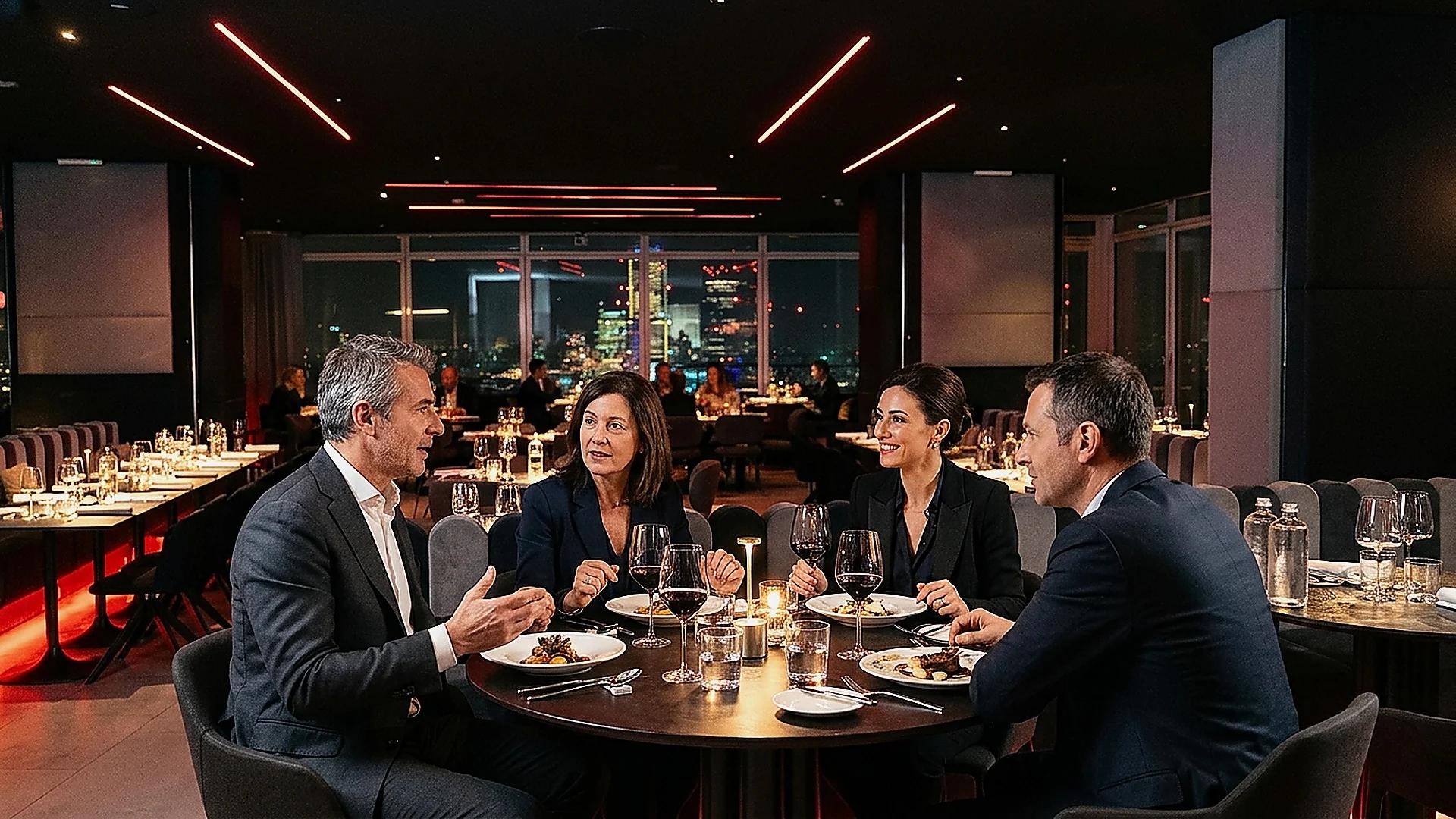
These three choices shape each other and should be made together. The date decides which rooms are free, the format decides which room you need, and sometimes the venue suggests the format.
The format
The most common formats are the seated dinner, the drinks reception or standing dinner, the party with music, the day of activities, and the convention with a plenary session and group work. Each has different timings, costs and atmospheres. If you are looking for inspiration, the guide to corporate event ideas sorts the suggestions by objective and by season. For formats that already have their own page, such as corporate dinners and team building, you will find all the details there.
The venue
To choose the venue, start from three questions: how many guests in the format you have picked, how they will get there, and how late you will stay. Everything else comes after. The corporate event venues we suggest most often are described with capacities and areas on their own page. If you already have a district in mind, there are guides to corporate events in CityLife and Portello, in Porta Nuova and Isola, and in the Tortona district.
The site visit
Never confirm a room you haven't seen. On the site visit, check the entrances, cloakroom, toilets, where the bar and the music go, where the speech will be given, and the light at the same time of day as the event. Bring along the person who will really decide: one extra site visit costs less than a badly chosen venue.
Invitations and RSVPs
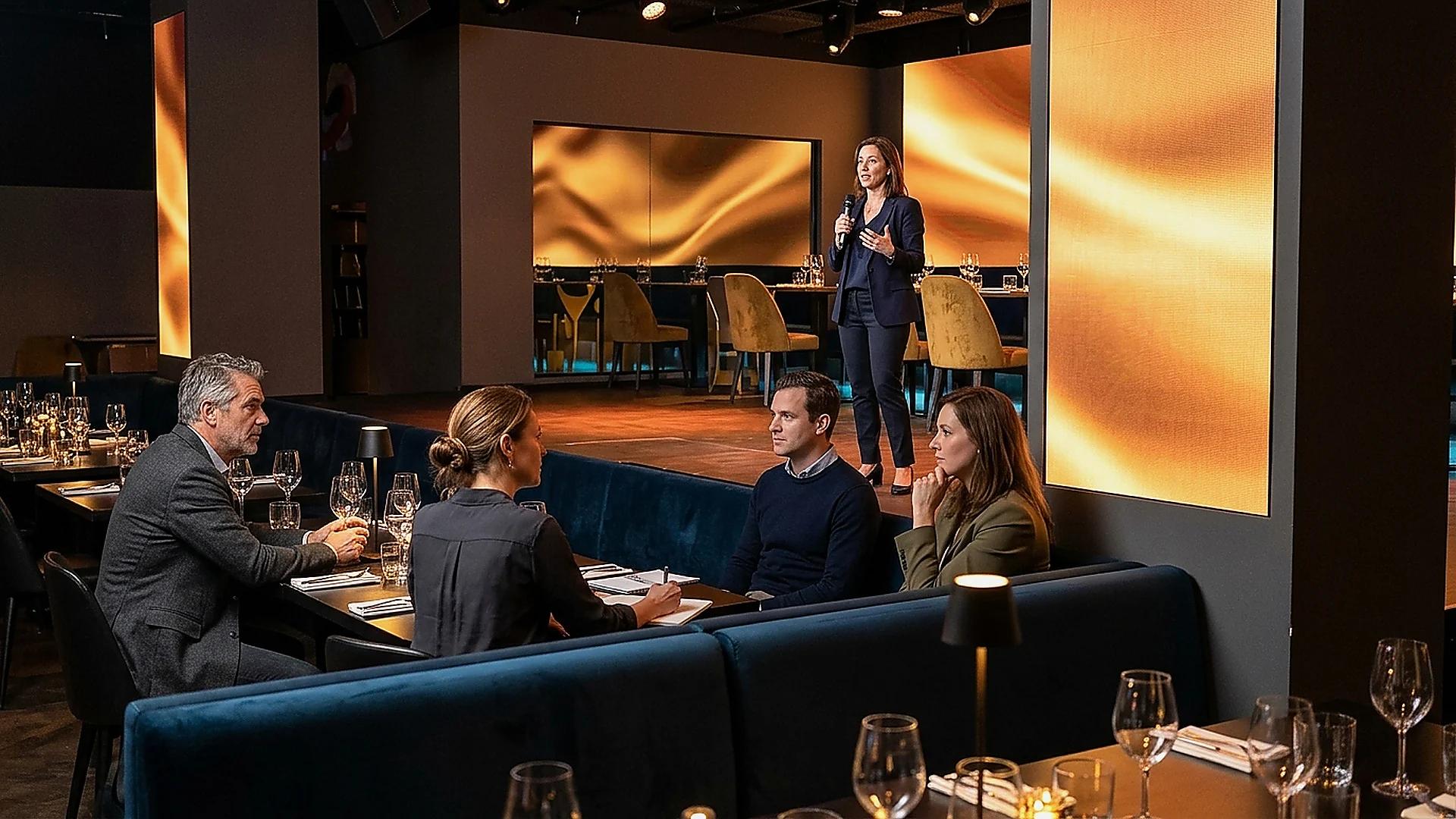
Invitations are the most underrated part of the organisation. A perfect event with half the guests missing is only half a success.
The save-the-date
Six to eight weeks before, send a short message: date, approximate time, type of event. You don't need the address yet. The point is to block out the diary, especially if the guests are clients or colleagues from other offices who have to arrange travel.
The formal invitation
Three to four weeks before, the real invitation goes out, with the place, the times, any dress code (smart casual, cocktail and so on), a form for confirming attendance and giving dietary requirements, a reply-by date and a contact for questions. If partners are invited too, say so clearly: it is one of the questions people ask most.
Reminders and privacy
Two weeks before, send a reminder to anyone who hasn't replied, and a week before, a practical message to those who have confirmed: address, how to get there, parking, times. If you collect personal data such as allergies or phone numbers, handle it according to the company's privacy notice. If there will be a photographer or filming, say so in the invitation.
Suppliers and contracts
What the quote should say
A good quote describes the event so that anyone can understand it: date, start and finish times, venue, private or shared room, menu, drinks in defined quantities, music, services included, cost per head, VAT, payment terms and the date until which the quote is valid. Anything not written down is not included.
The clauses to read
Before signing, read three points carefully: the deadline for confirming final numbers, what happens if the number of guests goes down, and the terms if the event is cancelled. These are the clauses that matter most when something changes, and something nearly always does.
Outside suppliers
If you are bringing your own supplier, for example a photographer or a set designer you trust, ask the venue whether that is allowed, what time they can come in and where they unload their equipment. Give the name to the organiser, so they can add it to the running order and the access list.
The day of the event, hour by hour
This is how a corporate evening with drinks, dinner and an after-dinner part usually unfolds. The times are an example to adapt.
| Time | What happens |
|---|---|
| 15:00 | Suppliers arrive, set-up, sound checks |
| 17:30 | Short meeting between the internal coordinator, the organiser and the room manager |
| 18:30 | Final check: place cards, badges, cloakroom, music |
| 19:30 | Guests arrive, welcome drinks |
| 20:30 | Guests take their seats |
| 21:30 | Speech or awards, between courses |
| 22:30 | Dessert and toast |
| 23:00 | Music, bar and after-dinner |
| 01:00 | Event ends, guests leave, extras settled |
The speech
If there is a speech, it should be short and come when attention is high: usually after the first course, not at dessert when half the room is on its feet. Test the microphone in the afternoon and decide who introduces whom.
The unexpected
A guest with an allergy nobody mentioned, a supplier running late, rain on the terrace. On the day you need one person who decides quickly and doesn't have to ask anyone's permission. That is usually the organiser's lead, in agreement with the internal coordinator.
A few habits that make the day easier
Keep one printed copy of the running order and the guest list with you, as well as the digital one: phones run out of battery and the venue's wifi is not always there when you need it. Agree in advance on one channel for messages between the organiser and the internal coordinator, so nothing gets lost across three different chats. And eat something before the guests arrive: whoever runs the evening rarely gets a proper meal during it.
After the event
Saying thank you
The next day, send the guests a thank-you message, with a photo from the evening if there was a photographer. With clients, the thank-you is also the moment to set up the next meeting.
Measuring
Send a short questionnaire of three or four questions within two days: after a week nobody replies any more. Compare the results with the objective in the brief. Note down what worked and what didn't: next year's event starts from there.
Closing the accounts
Collect the invoices, check they match the quote and any extras you agreed, and file everything together with the brief and the guest lists. The next internal coordinator will thank you.
The most common mistakes
- Starting from the venue rather than the objective. A beautiful room won't rescue an evening with no reason behind it.
- No budget in the brief. The proposals can't be compared and you lose a whole round.
- No decision-maker in the room. The venue goes while you are waiting for an answer.
- Late invitations. With less than three weeks' notice, attendance drops, especially with clients.
- Drinks not defined. The final bill surprises everyone.
- An overcrowded running order. Speeches, videos and awards one after another wear the room out.
- No plan B. For outdoor events, book the indoor room at the same time as the terrace.